Thursday, January 8, 2015

German Language Resolution Update

Maintaining thus far.  I currently have a 10 day streak going.  I plan to complete this full section next week.  I'll then spend the rest of January conditioning by doing strengthening exercises.

The next session is extremely long (106 lessons).  I'm guessing that will take at least February and March to complete.

Saturday, January 3, 2015

New Year's Resolution 2

I will learn 2 programming languages in 2015: Java and C.

To do this I will leverage free programming courses through MIT, Coursera, Code Academy, and KhanAcademy.

I will begin with C.  I plan to learn this well enough to write simple programs and have enough understanding to carry intelligent high level conversations with developers.  My understanding should be sufficient to allow me to take the Cloud Computing specialization through Coursera.

After this I will study Java.  I will learn this well enough to complete the Android Apps for Cloud Computing specialization at Coursera.

Wednesday, December 31, 2014

New Year's Resolutions: learn conversational German

For one of my personal resolutions this year, I plan to complete Duolingo's German course.  I currently have 138 lessons left. My plan is to:

1.  Average a lesson every other day.
2.  Complete an average of 2 strengthening practices each day.
3.  I will supplement this with watching at least 10 minutes of German speaking video per week.

Sunday, December 28, 2014

Micro-managing doesn't get more from employees

This study concludes what most probably already knew, micro managing is ineffective.

"When employees were pressured to work more, they were less inspired, she found. But when allowed to set their own pace, taking fewer vacations and working on weekends, they could accept it because it was their choice, Michel explained in the summer issue of The Sociological Quarterly, where her study was published."

Saturday, December 27, 2014

Economic Schools

This article provides an interesting chart of different schools of thought in economics.

Becoming more likable

Thought this was an interesting article and TED talk on how to develop your likability.

MBA progress 0.0

As part of my New Year's plan that I've decided to implement ahead of time (look at me getting all proactive already), I've decided to also use this space to write about my progress in the MBA program I started this month. 

The program is through the UW and specializes in Technology Management. It is an executive program, meaning it runs nights and weekends for 18 months. The first quarter, assuming one can call it that, was a week long (8 hours for 7 days) intensive study in Business Ethics, Professional Communications, Negotiations, and Team Building.

The next quarter begins 1/3 with classes in Financial Accounting, Stats, Micro Economics, and Prof Comm again.

New Year's Resolution(s)

This year I'm going to attempt a bit more proactive and aggressive approach to the whole resolution(s) bit.  First, I plan to post here on what my resolutions are to be.  I'll also be using this space to update on progress toward my 2015 goals.

Here's hoping that a) this will compel me to think more deeply than typical about these and b) help me to stick with things in a more than sporadic manner.

Thursday, May 17, 2012

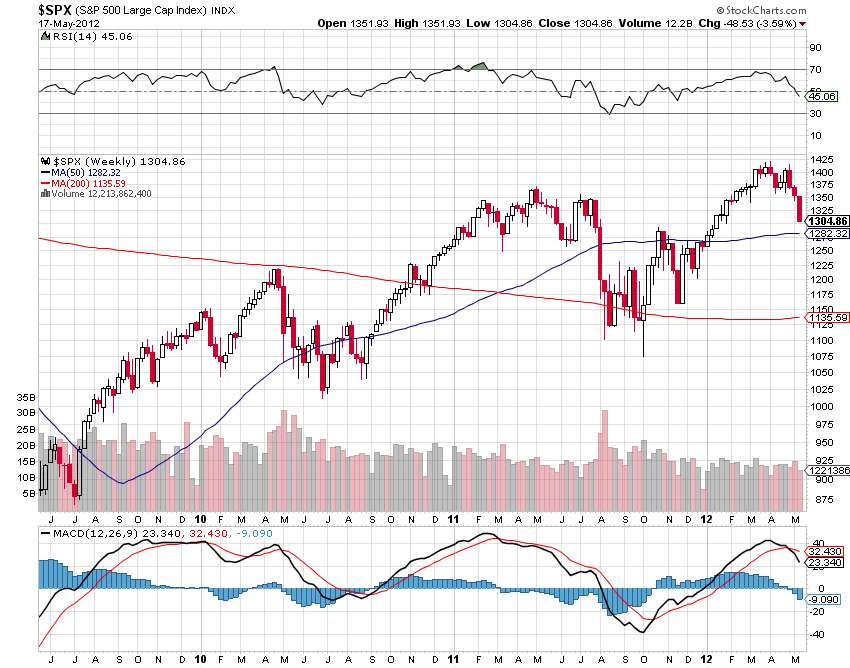
S&P 500 Weekly Figures

The S&P appears to be headed for a second week of negative MACD.  Fast too approaches the 50 week moving average - roughly equivalent to the 200 day MA; both of the past two summers' corrections have broken through this level, with 2011's precipitating a near bear market drop before staging a come back from November forward.

Visit StockCharts.com to see more great charts.

Sunday, February 19, 2012

Employment Impact Of Modern Recessions

Calculated Risk earlier today posted some interesting graphics comparing the job losses for recessions since the 30s.

Compared to all other recessions since the Great Depression, the one beginning in 2007-2008 has by far been the most devastating from an employment perspective, which is arguably the most important economic metric.


That said, judging the current recession versus the great depression, puts things in a very different perspective.

Forecasting a linear trend from the low of the current cycle through the data presented would argue for another 2-2.5 years before hitting the same number of jobs as we had in the prior peak.

However, as evidenced by the Great Depression data, the numbers can plunge again even after a positive trend presents itself. It took an additional 2.5 years to get to the same number of jobs after the second dip occurred around 1937 (which coincided with Fed changes as "hawks" pushed for higher rates to ward off inflation fears).

Saturday, February 18, 2012

Daily Percentage Based Point & Figure Analysis - 2/17/2012

The S&P is within 1% of breaking multi-year highs. With Greece needing a win before the end of March, which it'll likely get in the form of another kick-the-can fiscal procedure shortly, I'd expect a significant break upward for the S&P similar to the set up seen already in the NASDAQ.
Meanwhile, both the DOW and NASDAQ have broken through to multi-year highs, with the NASDAQ up substantially over its April - June 2011 levels.

Saturday, February 11, 2012

Seattle Housing Inventory Declines Dec - Jan

Seattle Bubble's got an interesting article about housing inventory. Based on their data, 2012 is the first year since at least 2000 where the monthly change in housing inventory has been negative from December to January.

This confirms more anecdotal evidence around the Seattle area with significant numbers of pending homes, but few new ones coming to market.

Tuesday, February 7, 2012

US Long Term Home Prices

Here are two views on the long term trend for US home prices. Many argue that the long term real home price change is between 0% and 2%.

Taking Shiller's annual home price index yearly data back to 1890, one view is to take the linear trend of the real prices and measure where we're at compared to where we "should" be based on this trend. However, the trend here is based on a substantially "negative" event near the beginning (the Great Depression) and a significant "positive" event in the more recent past (the 2000s bubble).

These two events could cause a shift in the underlying "real" trend in a positive manner. One way to remove that bias is to look at the impact is to remove those two periods. While this reduces the number of observances for the trend, if the observances removed are believed to be abnormal, this may be justified.

Hence, the second line uses the period from 1950 to 2000 to develop the trend. Interestingly, when forecast back to 1890, the forecast number is only 0.4% off from the actual.


So, what's this mean? Based purely on these two views of the long term trends in housing prices we find two similar, but slightly different, current states.

Under the normal long term linear trend the US Housing Index has been under where the trend would have us for the past two years, currently under by -6.3%. Using the more limited 1950-2000 data set, the 2011 level of 120.08 is still 4.1% over the trend.


S&P 500 w 200 Day Moving Average Percent Bands

Using a simple technical indicator method of choosing buy/sell opportunities on the S&P 500, purchasing when the index rises above 101% of the 200 day moving average and selling when it drops below 99% of the same, the last "BUY" signal occurred on 1/3/2012.

With today's close of 1347.05, the last purchase in would amount to a 5.48% increase.

Sunday, February 5, 2012

S%P 500 with 200 Day Linear Trend Points

Consumer Price Index Inflation (excluding food and energy)

Judged based on the Consumer Price Index, removing the volatile food and energy components, core inflation has increased by nearly 1.3 percentage points in the past year. At 2.23%, annual inflation is now at a level not seen since October 2008.

This level could make it more difficult for the Fed to ease more, regardless of the changes to language around it's dual mandate.

Fun from XKCD.com

Hi! Someone call for me? I'm a superhero who specializes in the study of God's creation of Man in the Book of Genesi-- HOLY SHIT A GIANT BUG!

Daily Percentage Based Point & Figure Analysis

On a daily basis, the P&F chart clearly shows the S&P 500 to be hitting major resistance levels. I'd expect some significant pressure from this level. However, we're less than 2% away from breaching multi-year highs.
Meanwhile, the Dow Jones Industrial average has breached it's multi-year high (surpassing the April 2011 levels) and is at levels not seen since the beginning of the recession in 2008.

Saturday, February 4, 2012

Rate of Unemployment vs Employment

Below are the unemployment and employment rates both viewed on a monthly basis. While there has been much ado about unemployment dropping (it has fallen 8 tenths of a point in the past year), the employment rate has maintained at a fairly steady state over the same time period (increasing 1 tenth of a point since January 2011).

Since the unemployment index drops those who are no longer seeking employment, this growing divide (falling unemployment with stagnant employment) could be a sign that the labor market isn't picking up so much as people are turning off from looking for new jobs.


Sunday, July 24, 2011

Debt Limit Extentions

Stephen Bernard, in a WSJ article today, on some of the potential market action over the coming week depending on how the debt limit conversation plays out.

Key points from their perspective:
--"Markets bracing for a rocky start if no U.S. debt deal is announced"
--"Relief rally could kick off the week if deal made"
--"Terms of deal could weigh heavily on risks of ratings"

Boehner's scheduled appearance for this evening to discuss a plan passed without apparent comment from his office. If no deal is reached, or even if only a short term deal is reached, long term bonds would suffer with ten years increasing from 2.964% or 3.10% Monday alone according to John Canavan, market analyst at Stone and McCarthy Research Associates. In this case we'd probably also see moves toward commodities and into Yen and Swiss Franks due to their stability.

There's likely a lot of money sitting on the sidelines waiting to see what happens, though. If a long term plan does come out it will be interesting to see how significant the ensuing rally becomes.

If the outcome is a short-term solution that gets us through until 2012, it will be interesting to see what happens politically. Obama's already said he'd veto such a bill, but that was when there was sufficient time to do something different, with the deadline 9 days away, he may be whistling another tune.